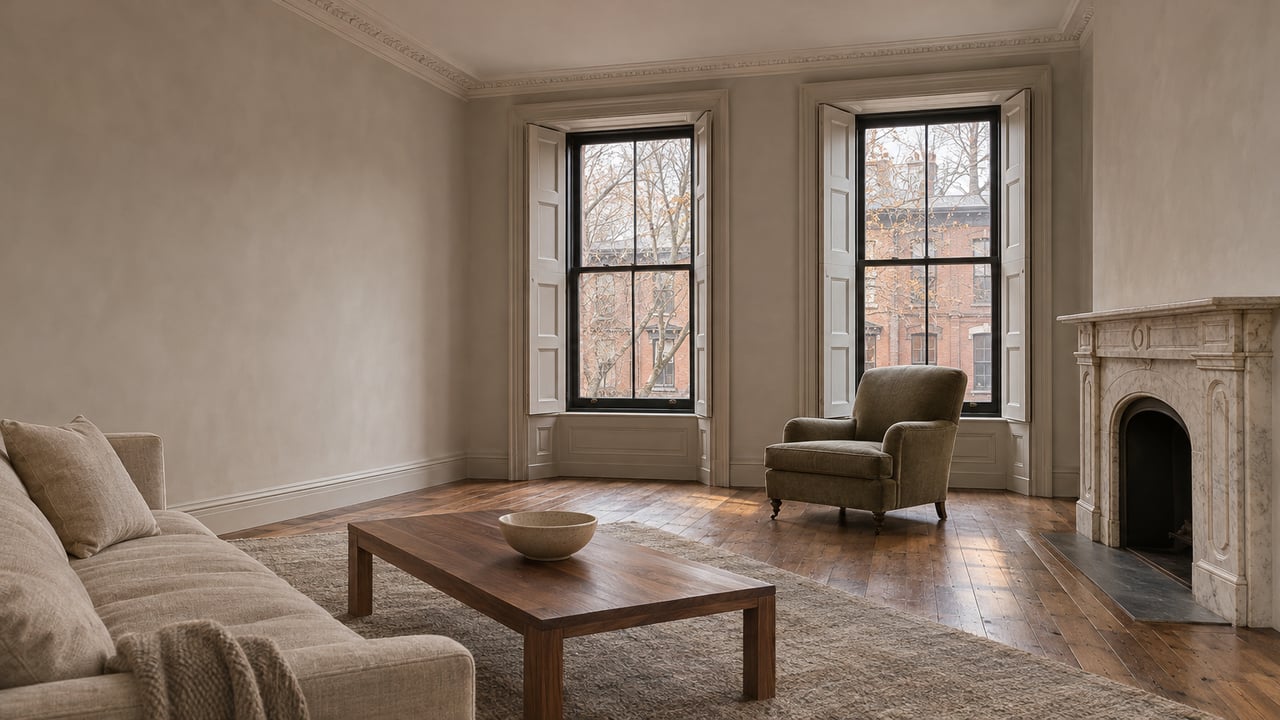
In August 2025, two townhouses on West 11th Street sold within two weeks of each other. The first was recorded on August 7. It was 230 West 11th Street, a three-story Italianate house built in 1860. It is 25 feet wide and has three wood-burning fireplaces and a terrace. The Real Deal described it as fully gutted, and it sold for $20 million.
The second was recorded on August 20. It was 310 West 11th Street, a single-family home of about 3,400 square feet with four bedrooms, outdoor space and a 20-foot facade. It sold for $9.6 million, slightly above its $9.5 million ask, according to The Real Deal's daily deals report.
So on the same street, a house that needed a full interior sold for more than twice the price of a four-bedroom single-family home. That makes sense once you look at what a West Village townhouse buyer is paying for. The price mostly follows three things: the original structure, the width of the facade and a deed held by one owner. For some houses, a fourth factor is what sits at street level. Kitchens, baths and millwork are the parts a buyer can change, and the market prices them that way.
The Interior Is the Replaceable Part
Appraiser Jonathan Miller explained this in his third-quarter 2026 commentary, which The Real Deal published on October 2. He wrote that almost no new townhouses are being built, "largely because buyers demand authentic turn-of-the-century structures even if the homes have been gutted to the party walls." He added that one- to three-family townhouses are about 2% of Manhattan residential sales, and that their prices have climbed steadily over the long run, which fits a housing stock that can't grow.
That changes how to read a listing. A buyer can rebuild an interior. A buyer cannot get an 1860 facade, a 25-foot frontage or a West 11th Street address any other way than by buying them. At 230 West 11th, the buyer paid $20 million for the part of the house nobody can reproduce. At 310 West 11th, the sellers had paid $6.8 million in 2010, so the house gained value over 15 years. Its price topped out at the value of a 20-foot house.
Width Sets the Ceiling
When you know how wide a West Village house is, you already know roughly what price range it will sell in. The recent sales line up that way.
At 20 feet, 310 West 11th sold for $9.6 million. At 25 feet, the gutted house on the same street sold for $20 million. Between them is 48 Jane Street, which is 22.5 feet wide with about 4,100 square feet, five bedrooms, a back garden and a cellar. The same family held it from 1996, when it passed through an estate, and the owners later renovated it with the architects Fairfax & Sammons. It first listed at $15.5 million. The Real Deal reported that it went into contract between September 21 and 27, 2026, asking just under $15 million. That made it the priciest of only 17 Manhattan homes asking $4 million or more to sign contracts that week.
At the top of the range, the price is set by houses made from two buildings. The double-wide at 105-107 Bank Street is a combination of two historic townhouses, according to The Real Deal. It asked $75 million when it listed in October 2025 and sold for $70 million in May 2026. The Real Deal put its size at 14,000 square feet. It came within a few million of the downtown record, a $72.5 million Greenwich Village sale in 2024. In this market, each foot of frontage moves a house into a different price range. A second building moves it into a range only a few houses ever reach.
One Deed, Two Owners
Ownership can pull a price down as far as width pushes one up. 197 West Houston Street is a red-brick two-family townhouse with oak floors, a working wood-burning fireplace and a walled back garden. Since the 1960s, two households have owned it 50/50 under a single deed as tenants in common. When the downstairs half came to market, the listing asked $1,875 per square foot, which it presented as 30% below the area's average townhouse price. The Real Deal reported that the home sat on the market for about a year and saw several deals fall apart before it closed for $2.1 million in May 2026.
According to the listing agent quoted in that article, the problem was financing. One interested buyer couldn't get a loan, and after that the listing was effectively shown only to cash buyers. The seller had paid $2 million in 2017 and spent roughly $500,000 on renovations, so nine years of ownership plus a renovation ended at about the original purchase price.
The downstairs unit had the brick, the fireplace and the garden. It did not have sole control of the building, and the price dropped to reflect that. Before talking about price on any West Village house that isn't one owner on one deed, a buyer should learn how it is owned.
When the Storefront Changes Who Bids
Some houses draw a different kind of buyer. 385 Bleecker Street, which also uses the address 87 Perry Street, is a three-floor townhouse with a two-bedroom residence above a ground-floor retail space. A shoe brand that closed in 2024 last occupied the shop. The residence rented for $16,000 a month in 2024, and the owner was asking $21,000 a month for it in June 2026.
The Real Deal reported that it sold off-market in August 2026 for just under $10 million to an entity linked to Acadia Realty Trust. Acadia already owns the building next door at 387 Bleecker and the nearby 382-384 Bleecker. For a house like this, the competing buyer can be a retail landlord assembling storefronts on Bleecker, not another household. If a house you're considering has a shop at street level, expect that kind of buyer in the same pool.
Why the Median Fell While Houses Held Their Value
According to The Real Deal's coverage of Miller's third-quarter report, the median Manhattan townhouse sale price for July through September 2026 fell 21% from a year earlier to $5.4 million. The report attributed the drop to a sales mix weighted toward smaller homes. In the same quarter, townhouse listing inventory fell 33% year over year. Miller's own commentary put the average townhouse sold that quarter at 4,552 square feet, down 7.9% from a year earlier. He said the smaller average size pulled down all three of his price measures, while the market pace was its fastest in more than four years.
The quarter before showed the same effect in the other direction. For April through June 2026, Manhattan townhouse deal volume rose more than 31% year over year, and the average sale price rose nearly 26% to $10.5 million. The Real Deal reported that the jump was driven partly by larger houses changing hands, including the Bank Street double-wide.
Across those two quarters, the size of the houses that sold changed, and the price measures moved with it. The gap between the two West 11th Street houses works the same way. A quarterly townhouse figure tells you which houses sold that quarter. It tells you very little about the house you're considering. For current conditions across the borough, our November 2026 Manhattan market update covers the condo and co-op side.
Reading a West Village Listing This Winter
Manhattan townhouse inventory fell by a third in the third quarter, so each West Village listing faces fewer alternatives. Four facts explain most of the price differences above, and they are worth getting before talking about renovation budgets.
- Frontage. Ask for the width in feet, not just square footage. A 20-foot house and a 25-foot house on the same street sold for prices more than $10 million apart in 2025.
- The original structure. Find out what remains of the original building behind the finishes. A buyer paid $20 million for a fully gutted 1860 house.
- The deed. Confirm that one owner holds title to the whole house. Shared ownership brought 197 West Houston down to roughly what its seller paid in 2017.
- The ground floor. Find out what is at street level. A storefront can bring in an investor buyer and change how the house is priced.
Our West Village neighborhood page and the Greenwich Village guide cover the blocks around these addresses.
FAQ
Do mortgage rates matter at this price point? They matter less than in the rest of the market. Speaking about the top half of the Manhattan market in the October 2 report, Miller said most buyers there pay all cash. He also said buyers below $1 million are the most sensitive to rate changes. The 197 West Houston sale shows that the way a house is owned can rule out a mortgage before rates even come up.
Where does the downtown ceiling sit right now? The record is $72.5 million, set by a Greenwich Village townhouse in 2024. The closest recent sale is 105-107 Bank Street at $70 million in May 2026. Both sit far above the $9.6 million to $20 million range of the 20- to 25-foot houses on West 11th Street.
If you're weighing a West Village townhouse and want to know what a particular facade, deed and ground floor are worth before you discuss renovation, the advisors at Howard Hanna NYC can review the house with you against recent sales on nearby blocks. Schedule a Call and bring the listing.