THE PIED-À-TERRE TAX SERIES PART 3

Photo by Rihards Gederts | Howard Hanna NYC
Published October 28, 2026 - Data through September 30, 2026
New York City's pied-à-terre surcharge applies from the 2026–27 tax year, which began July 1, so the third quarter is the first full quarter under the tax. Manhattan's $5M+ closings rose, but the mix shifted down: deals between $5 million and $8 million jumped, while those of $8 million and above fell by about a quarter.
Short answer: Did the tax slow Manhattan's luxury market in its first full quarter? Not by count. Manhattan recorded 206 closings of $5 million or more in Q3 2026, 7% more than at the same point in 2025, based on Howard Hanna NYC's analysis of NYC ACRIS deed records.
Q3 2026 at a glance (Manhattan deeds of $5M or more, counted the same way each year)
- 206 closings recorded by September 30, up 7.3% from 192 a year earlier. Counting only condos and one- to three-family homes, the types the surcharge covers, closings rose 3.7%.
- About 225 to 240 closings expected once late deeds post (our estimate), above 2025's final 214
- $5M to $8M closings up to 131 from 94, while $8M and above fell to 75 from 98
- Median closing price $7.00M, down from $8.00M, as more deals closed under $8M
- 65.0% of closings fit our non-resident buyer profile (defined below), against 66.7% a year earlier
- Brooklyn: 58 closings of $5M or more, up 29% from 45
Closings trail contracts by weeks or months, so this is an early read on the tax, not a verdict. The surcharge remains in effect while the city appeals a September 29 court ruling on how it was rolled out.
Did the pied-à-terre tax slow Manhattan's $5M+ market?
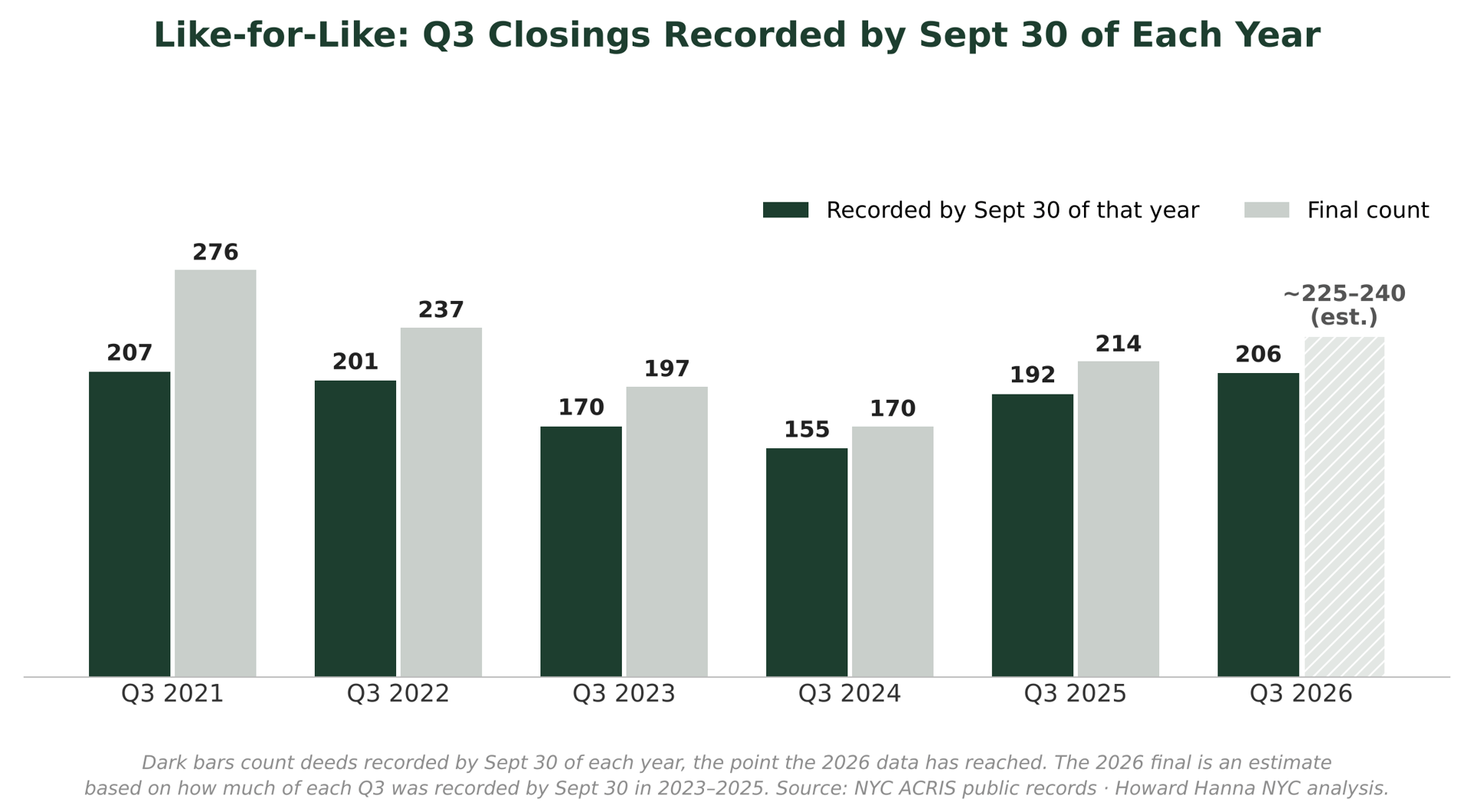
Deeds take time to reach the public record, so we compare like with like: each year's third quarter counted only with deeds recorded by September 30 of that year. On that basis, July rose to 85 closings from 77 and August was slightly softer at 75 against 77. September, still filling in, ran 46 against 38.
If late deeds post at their 2023 to 2025 pace, the quarter would finish at roughly 225 to 240 closings, above last year's 214. That is our estimate, and we will report the actual count next quarter.
Year to date the picture is similar: 663 closings through September against 625 at the same point in 2025, up 6.1%, with dollar volume up 5.7% to $6.68B. Monthly counts show no drop after July 1, though closings trail contracts.
An update to Part 2: with late deeds now recorded, first-half 2026 closings were up 5% on 2025, not down 3.5% as we reported in August. The revision note under How we measure explains why.
Which price ranges grew, and which fell?
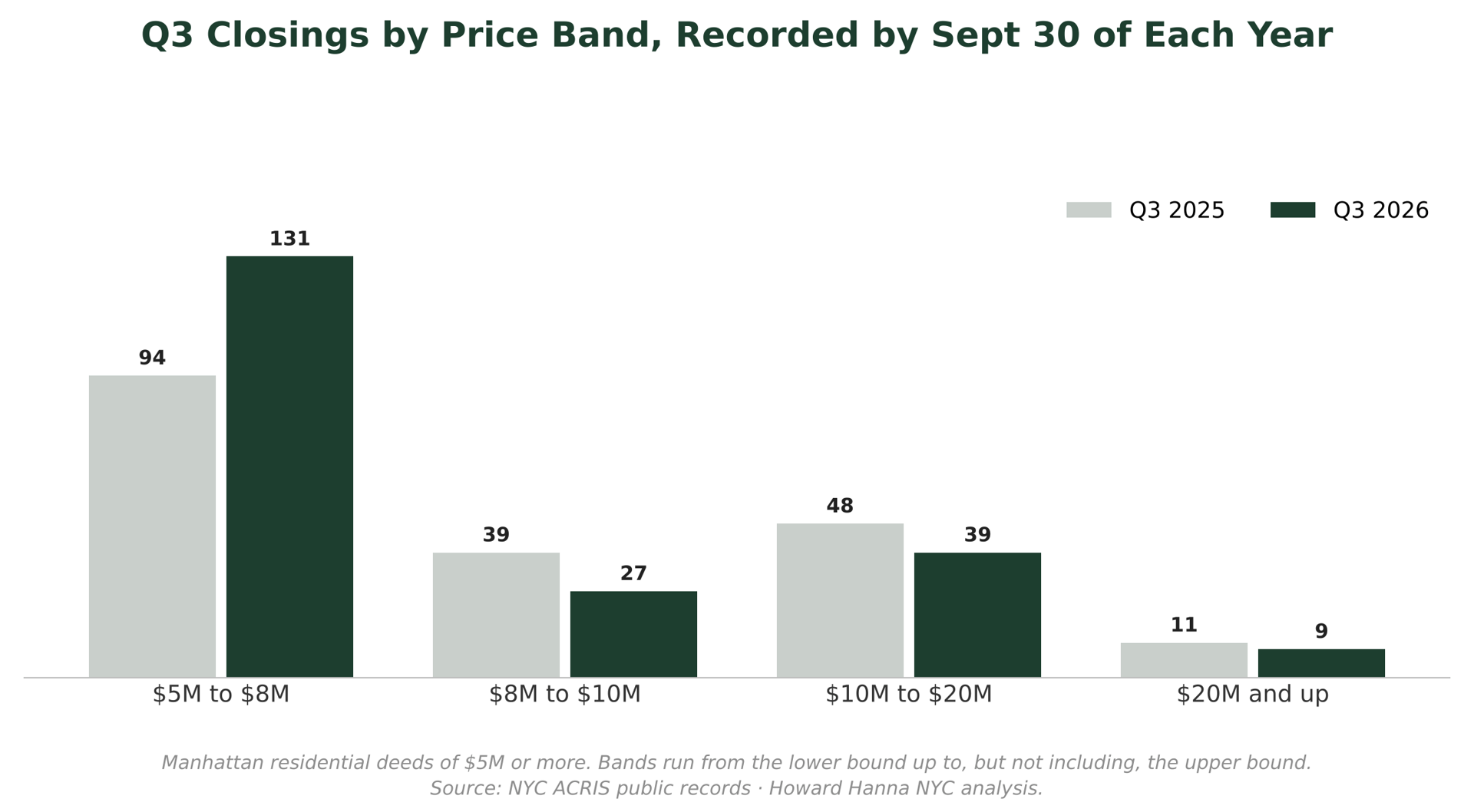
The clearest change was in the price mix. In Part 2 we said $5M to $8M closings might be among the first to show a response to the tax. They rose.
At $8 million and above, closings fell to 75 from 98, and the $20M+ band is too small to read on its own. The median fell to $7.00M from $8.00M and the average to $9.04M from $9.82M, while dollar volume was roughly flat at $1.86B against $1.89B. Townhouses made up 18% of closings, down from 22%.
One quarter cannot say why. Other forces were in play: Manhattan townhouse inventory fell 33% from a year earlier, according to appraiser Jonathan Miller's data, as The Real Deal reported. The tax may be one factor among several, and the data does not separate them.
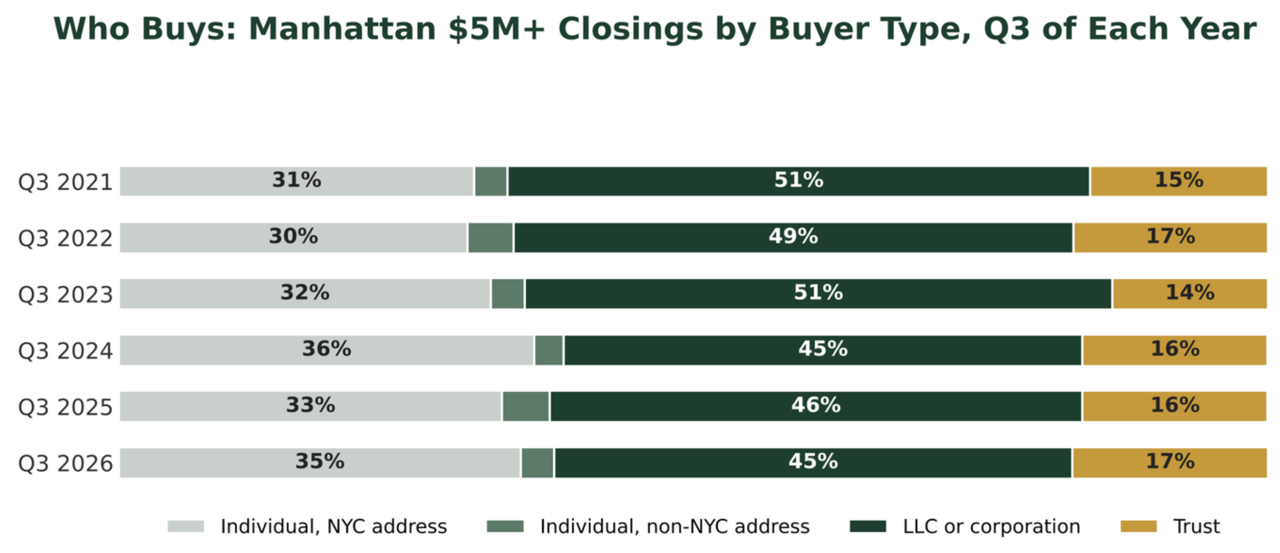
How did buyers take title in Q3?
The buyer profile barely moved. On the same basis, 65.0% of Q3 closings fit our non-resident buyer profile, against 66.7% a year earlier. Every third quarter since 2021 has fallen between 63.9% and 69.7%.
How we define it: a closing fits the profile when the buyer is an LLC, corporation or trust, or lists a mailing address outside New York City. It is a pattern in public deed records, not a measure of anyone's residency or citizenship.
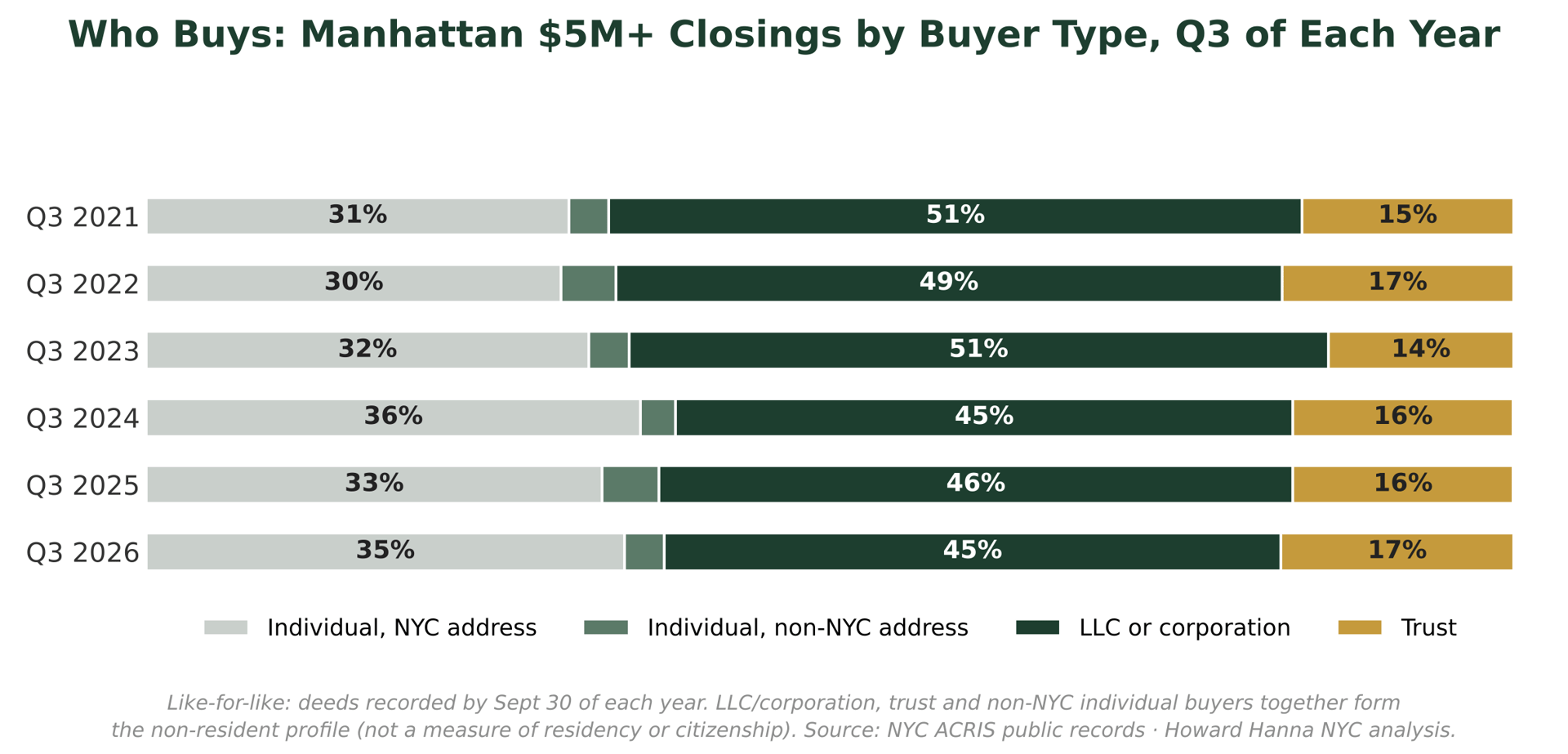
LLC and corporate buyers made up 45% of Q3 closings (46% a year earlier) and trusts 17% (16%). On a full-year basis, trust buyers have run near 16% to 17% since 2024, up from 11% to 13% in 2021 through 2023.
One piece did shift: fewer buyers listed a mailing address outside New York City, 11.7% of Q3 closings against 18.8% a year earlier, and 12.4% year to date against 16.2%. The share was already 12.3% in the first quarter, before the tax was announced in April, so we read it as a pattern to watch, not a post-July change.
What happened in Brooklyn?
As promised in Part 2, the series now covers Brooklyn, measured the same way. Brooklyn's $5M+ market is small but growing: 58 third-quarter closings were on record by September 30, up 29% from 45 a year earlier.
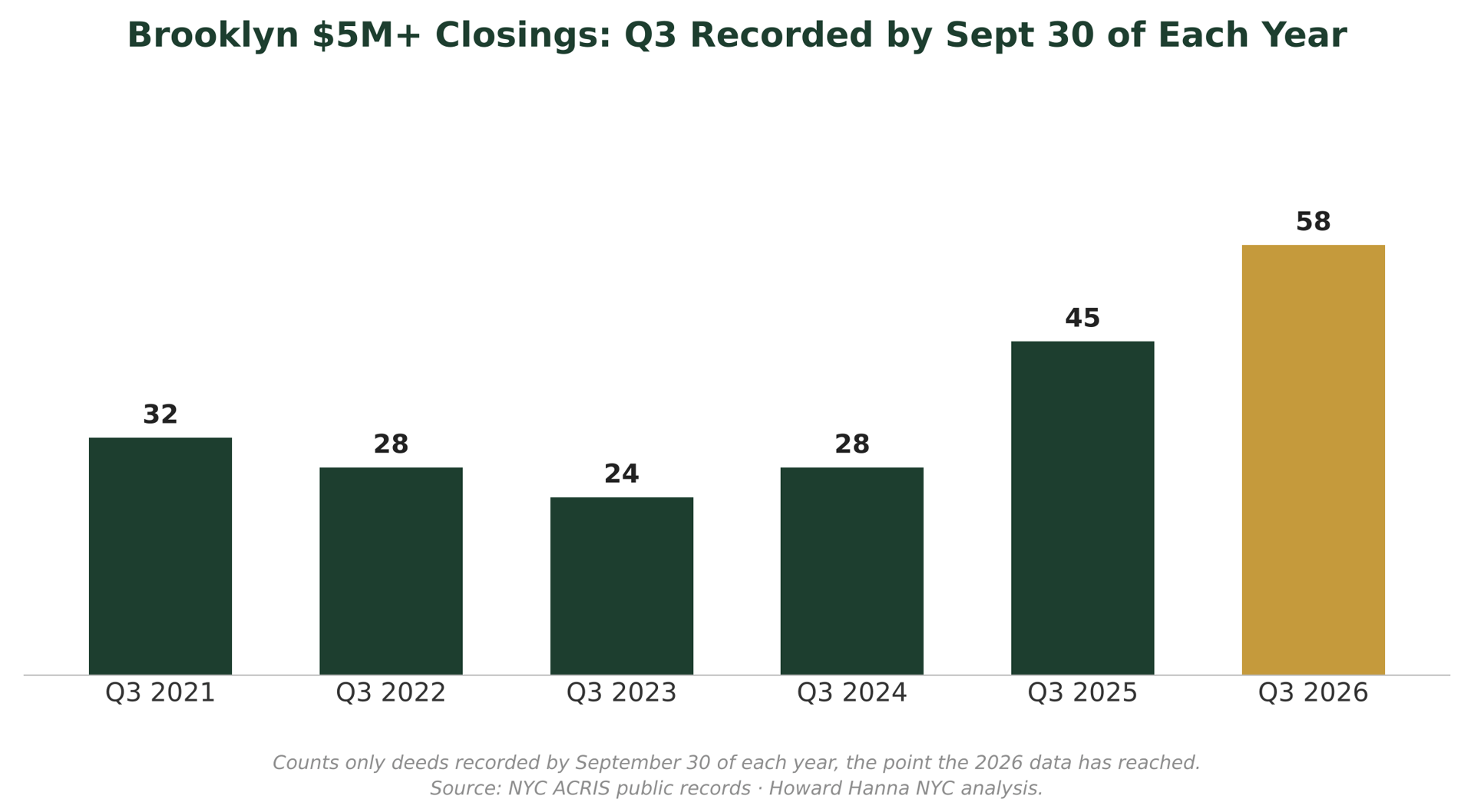
Brooklyn recorded 140 closings through September, up 24% from 113 at the same point in 2025 and already about 90% of 2025's full-year high of 156. Year to date, 62.9% of Brooklyn closings fit the non-resident buyer profile, against 58.4% a year earlier and 68.3% in Manhattan. The year-to-date median was $6.19M, against $6.20M.
Quarterly samples are small, so we read Brooklyn's shares on a year-to-date basis. The surcharge applies in Brooklyn on the same terms as in Manhattan.
How does the NYC pied-à-terre surcharge work?
The surcharge is an annual charge, on top of regular property tax, for certain high-value homes that are not used as a primary residence. It is a percentage of the property's Department of Finance (DOF) market value, not its sale price.
Property type | DOF market value | Annual rate |
|---|---|---|
One- to three-family home | More than $5M to under $15M | 0.8% |
One- to three-family home | $15M to under $25M | 1.05% |
One- to three-family home | $25M or more | 1.3% |
Condo or co-op unit | $1M to under $3M | 4.0% |
Condo or co-op unit | $3M to under $5M | 5.25% |
Condo or co-op unit | $5M or more | 6.5% |
Rates for tax years 2026–27 and 2027–28, per the NYC Department of Finance.
Condo and co-op rates are higher, but they apply to DOF market values that typically sit well below sale prices. At the published rates, a condo with a DOF market value of $1.4M would be charged $56,000 a year if the surcharge applied, and so would a one- to three-family home valued at $7.0M.
DOF says the surcharge generally does not apply if the home is the primary residence of:
- the owner
- a tenant or subtenant
- one or more individuals who hold a majority interest in the LLC, corporation or partnership that owns it
- an immediate family member of the owner or majority interest holder
- the sole beneficiary or beneficiaries of a trust that owns it
Whether any of these fits a specific property is a question for a tax professional or attorney.
For properties found subject, DOF says the charge will appear on the property tax bill due January 1, 2027. Separately, the city's co-op and condo tax abatement, a 17.5% to 28.1% cut in property tax, is limited to primary residences, as The Real Deal noted on October 14.
Where does the pied-à-terre tax stand now?
The surcharge is in effect, and a court fight over how the city rolled it out is on appeal. The Appellate Division said it will decide by November 10, 2026, 1010 WINS reported on October 6.
Date (2026) | What happened |
|---|---|
Oct 14 | The New York Daily News reported that fewer than 9,000 homeowners will be subject. About 11,000 owners had applied for exemptions; about 6,800 had been granted and about 3,800 were still being processed. |
Oct 13 | The deadline to apply for a 2026–27 exemption passed, after being extended to this date (DOF). |
Oct 6 | The Appellate Division, Second Department, paused the September 29 order while it hears the city's appeal, so the rollout continues (1010 WINS). |
Sep 29 | In O'Brien v. City of New York, a Staten Island judge found the rollout arbitrary and capricious and ordered the city to cancel the notices, remove the supplemental roll and make individualized determinations. The ruling did not strike down the tax, and the city appealed the same day (Thomson Reuters). |
Sep 28–29 | Separate lawsuits challenging the law itself were filed against the state (amNY). |
Jul 23–24 | DOF began mailing notices, to about 17,000 owners in all, and posted a list of properties that may be subject (Thomson Reuters). |
Jul 1 | The 2026–27 tax year began, the first the surcharge covers. DOF has published rates for 2026–27 and 2027–28. |
May 28 | The law took effect (DOF). It sunsets June 30, 2031 unless renewed. |
The state has said the tax will bring the city $500 million a year, and city officials told the Daily News they were confident it would. The appeal concerns how the rollout proceeds; the separate suits challenge the law itself. We take no view on either, and litigation can change quickly.
What does this mean for sellers and buyers?
For owners thinking about selling, closings at $5M+ held up in the quarter, led by the $5 million to $8 million range, with fewer closings above that. If the surcharge is part of a decision to hold or sell, talk to a tax adviser or attorney first. Our agents can show what a property would sell for today.
For buyers, the surcharge is a potential annual cost tied to a property's DOF market value and to how the home is used. A buyer who will live in the home as a primary residence is in a different position from one buying a second home. That difference belongs in a conversation with a tax adviser before you sign, and how the contract treats the surcharge is a question for your attorney.
Frequently asked questions
What is the NYC pied-à-terre tax?
An annual surcharge on certain New York City homes that are not used as a primary residence, charged on top of regular property tax. The law took effect May 28, 2026, the surcharge applies from the 2026–27 tax year that began July 1, and the law is scheduled to sunset June 30, 2031 unless renewed.
Which properties could be covered?
For tax years 2026–27 and 2027–28, one- to three-family homes with a DOF market value of more than $5 million, and condo and co-op units with a DOF market value of $1 million or more. Primary residences are generally not covered.
Is the tax still in effect after the September court ruling?
Yes, as of October 28, 2026. The September 29 decision addressed how the city identified and notified owners and did not invalidate the tax. On October 6 the Appellate Division paused that ruling while it hears the city's appeal. Separate suits challenging the law itself are pending.
Can owners still apply for an exemption?
The application deadline for 2026–27 closed on October 13, 2026. DOF says owners whose applications are denied, or who believe a property is incorrectly valued, can go to the NYC Tax Commission. Owners with questions about their options should speak with a tax professional or attorney.
How is the surcharge calculated?
As an annual percentage of the property's DOF market value, not its sale price: 0.8% to 1.3% for one- to three-family homes and 4.0% to 6.5% for condos and co-ops, depending on the value bracket.
Is Manhattan's luxury market slowing because of the tax?
Overall closings rose in the third quarter when counted the same way as last year, though closings of $8 million or more fell as the mix shifted toward $5M to $8M homes. One quarter is too short to separate the tax from other influences such as inventory and pricing.
This FAQ is general information, not tax, legal or financial advice.
What we'll track next
The fourth-quarter installment will report the final Q3 count against our estimate. We will also cover the appeals court's decision, the non-NYC address share, whether the shift toward $5M to $8M closings holds, and how Brooklyn develops.
Questions about a specific property? Our team can look up a property's DOF market value in public records and show which published rate bracket it falls in. This is general information only and does not determine whether the surcharge or any exemption applies. Contact us at [email protected] or (212) 729-5712, or connect with one of our agents.
New to the series? Start with Part 1 and Part 2.
How we measure
We analyze recorded deeds of $5 million or more for Manhattan and Brooklyn condo units and townhouses from ACRIS, New York City's public property record. As in Parts 1 and 2, townhouses here means one- to six-family houses. Co-op sales are not recorded as deeds and are not included.
Each closing is checked against the non-resident buyer profile defined above, using only what the public record shows about the buyer. It is a directional measure, not a determination of anyone's residency.
Timing. Recent deeds take time to appear in public data, so each year's third quarter is compared using only deeds recorded by September 30 of that year. The full-quarter figure is our estimate, and figures for recent periods can change as late deeds are recorded.
Scope note. Four- to six-family houses, which the surcharge does not cover, made up 9 of this year's 206 Q3 closings and 2 of last year's 192. Counting only condos and one- to three-family homes, Q3 closings rose 3.7%, and 63.5% fit the non-resident profile against 66.3% a year earlier.
Revision note. With June now fully recorded and a broader count of Manhattan deeds, first-half 2026 closings stand at 457, up 5% on 2025, rather than the 3.5% decline we reported in Part 2 when June was incomplete.
Sources
- Transaction data: NYC Department of Finance ACRIS records via NYC Open Data. Howard Hanna NYC analysis of Manhattan and Brooklyn residential deeds of $5 million or more, January 2021 to September 2026.
- NYC Department of Finance: Non-primary residence surcharge (rates, exemptions, deadline and billing).
- Thomson Reuters Checkpoint, October 1: the September 29 ruling.
- 1010 WINS, October 6: the appeals court stay.
- amNY, September 29: the challenge to the law itself.
- New York Daily News via CPA Practice Advisor, October 14: exemption and scope figures.
- The Real Deal, October 14: the co-op and condo abatement.
- The Real Deal, October 2: third-quarter Manhattan market report.
By Howard Hanna NYC Research - Rihards Gederts
If you would like to chat about the most recent market activity,
feel free to contact us at [email protected] or connect with one of our Advisors.
Howard Hanna NYC brings the nation’s largest independent and family-owned brokerage to New York City, uniting the strength of a national network with the insight and sophistication of a local firm. Formed through joining forces with Elegran Real Estate, Howard Hanna NYC delivers a seamless, full-service experience backed by more than 15,000 agents across 500 offices in 14 states. The firm’s forward-thinking, agent-first culture continues to shape the future of real estate across Manhattan and the Tri-State area. Learn more at www.howardhannanyc.com.