THE PIED-À-TERRE TAX SERIES PART 2
The tax's rollout is now legally contested. Homeowners sued the city last week over how taxable properties were identified, and on Aug. 10 a state judge issued a temporary restraining order pausing enforcement and the city's published property list; the city has appealed, and a hearing is set for Aug. 31. The rollout's legal footing remains unsettled — all the more reason to look closely at what the underlying transaction data actually shows.
Earlier this summer we published the first installment of this series: a look at who buys Manhattan's most expensive homes, built from five and a half years of public deed records, on the eve of New York City's new pied-à-terre tax. We promised to keep measuring as the tax moved from proposal to reality.
Reality moved fast. The surcharge took effect on July 1. On July 21, the Department of Finance issued twelve pages of rule amendments after a heavy comment period — broadening how owners can document primary residency and requiring determination notices to state the projected surcharge and the appeal deadline. And on July 23, Mayor Zohran Mamdani and DOF Commissioner Richard Lee announced that the first notification letters were in the mail, alongside a dedicated surcharge webpage — nyc.gov/npsurcharge — with an exemption eligibility tool, guidance, and a secure portal for submitting documentation.
One day later, on July 24, the city went further and published its supplemental market-value roll — a public list of roughly 26,000 properties citywide that may fall within the surcharge's scope. That word "may" is doing real work: the city is deliberately casting a wide net, and many owners will receive letters or find themselves on the roll for properties that are not ultimately subject to the tax — primary residences, homes occupied by family or bona fide tenants, and co-op buildings listed whole even though most of their units will be exempt. Inclusion is the start of a process, not a bill — a point the city itself underlined on August 1, when it extended the exemption-application deadline by nearly a month, to September 18, 2026, and expanded outreach across the boroughs to help noticed owners document that they don't owe it.
“Today is the first step in implementing this tax and collecting critical revenue to fund our parks, schools and libraries.”
Mayor Zohran Mamdani, announcing the notification letters, July 23, 2026
This update covers the second quarter of 2026 — the last full quarter closed entirely before the tax existed in force. It is, in effect, the final reading of the market's untreated baseline.
Key takeaway: In the last full quarter before New York City's pied-à-terre tax took effect on July 1, Manhattan's $5M+ market showed no rush to beat the deadline and no retreat: first-half 2026 closings were 3.5% fewer than a year earlier, but dollar volume rose to $4.42B and the median price reached $7.77M, the highest first half since 2022. The share of purchases fitting a non-resident buyer profile stood at 71.4% — off its early-2026 peak, still the second-highest first half in our six-year dataset. Figures are a directional proxy drawn from public ACRIS records, not a verified count. |
Our Approach, Briefly
Our method is unchanged from the first installment, so every figure here is directly comparable. We examine Manhattan residential deeds — condos, co-ops and one- to three-family homes — of $5 million or more in NYC's public property record (ACRIS), and flag each closing against a non-resident buyer proxy: an entity or trust buyer, or a buyer whose mailing address of record is outside New York City. It is a directional proxy, not a verified count — a deed shows structure and address, not residency. Recent months also carry a recording lag of 60–90 days for the newest deeds, which matters for June, and we flag it where it does.
We focus on Manhattan because that is where the tax's weight falls: Manhattan accounts for roughly 71% of the nearly 26,000 properties on the Department of Finance's supplemental market-value roll for the surcharge, published July 24 — and about 73% of their combined $185 billion DOF market value.
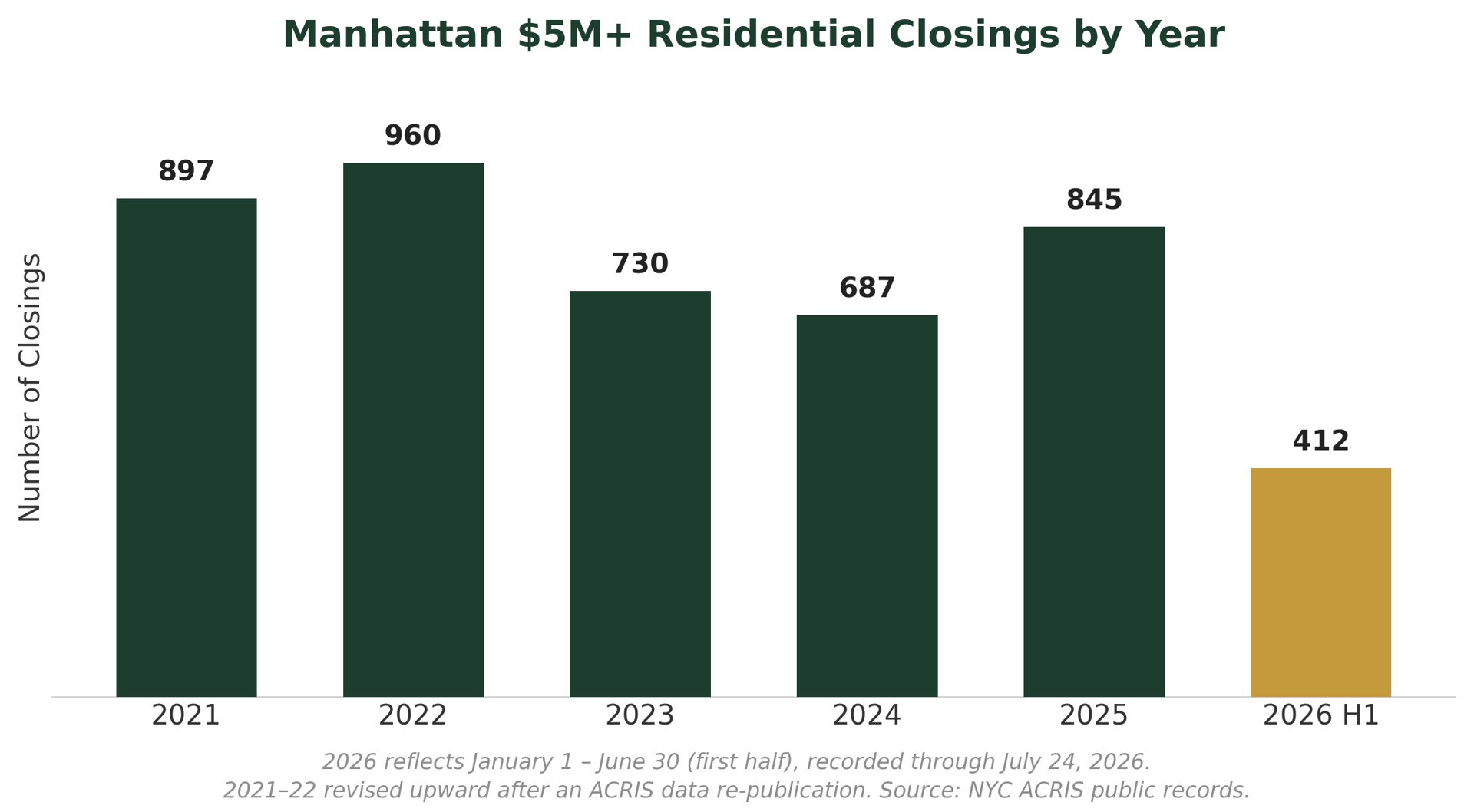
Data revision note: between installments, NYC re-published historical ACRIS partitions. Our 2021 and 2022 totals rose to 897 (from 837) and 960 (from 893); every record in the prior pull is contained in the current one, and the additions carry original 2021–22 recording dates. 2023–2025 are unchanged at 730 / 687 / 845. No directional finding is affected.
What the Data Shows
H1 2026 CLOSINGS 412 -3.5% vs H1 2025 | H1 2026 $ VOLUME $4.42B +1.2% vs H1 2025 | H1 2026 MEDIAN $7.77M +2.9% vs H1 2025 | NON-RESIDENT, H1 71.4% -1.7 pp vs H1 2025 |
First, the headline: no rush, and no rupture. The first half of 2026 closed with 412 sales of $5 million or more — 3.5% fewer than the first half of 2025 — yet total dollar volume edged up +1.2% to $4.42B, and the median price rose +2.9% to $7.77M, the highest first-half median since 2022. Strength is concentrated at the top: 36 closings of $20 million or more posted in H1 2026, against 31 a year earlier — though at fewer than 40 closings a half, that segment is a small sample best read directionally. Fewer deals, bigger deals.
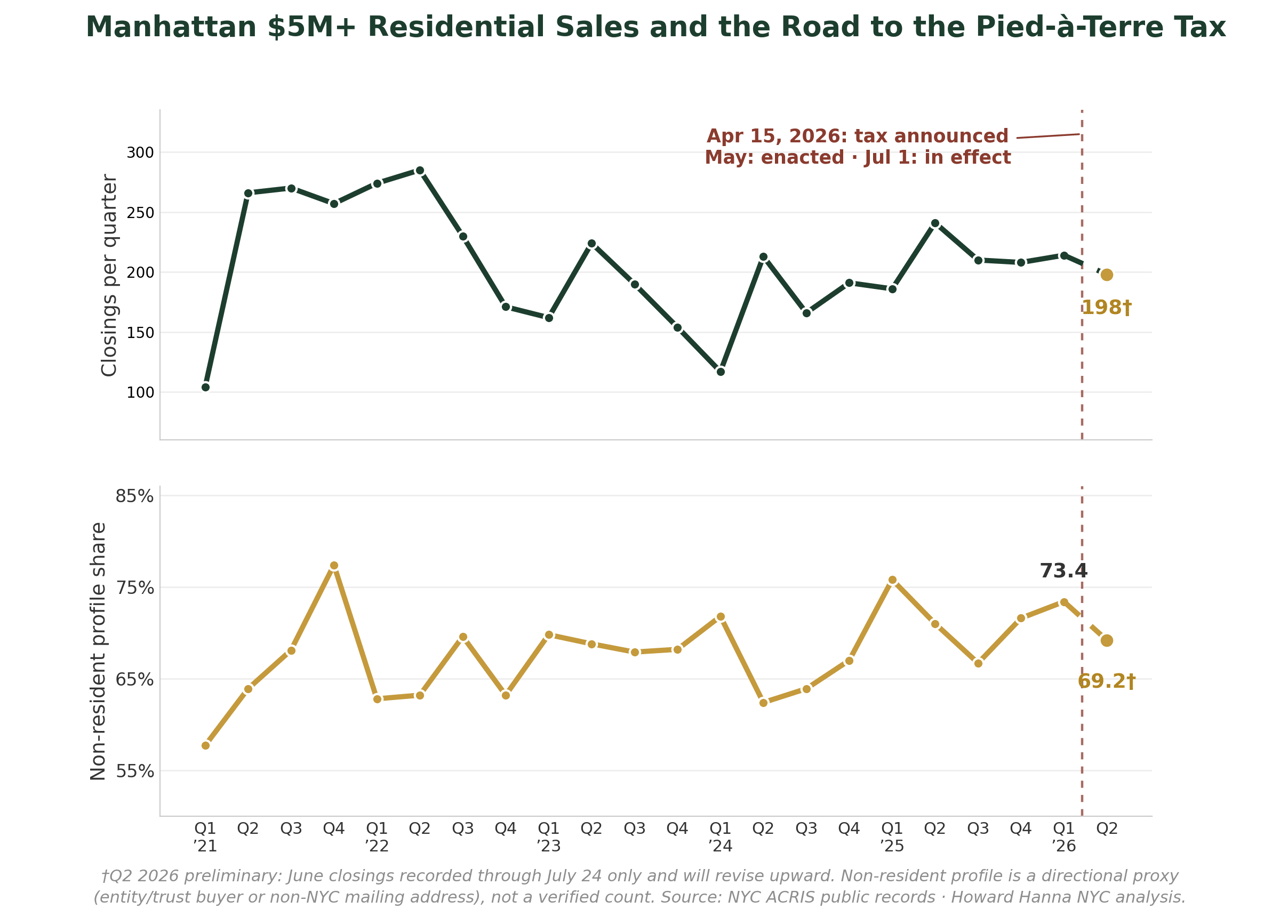
The quarterly split tells the more interesting story. The year opened strong — Q1 2026 closings ran 214 against 186 in Q1 2025, up 15% — and then Q2, the quarter in which the tax was announced (April 15), enacted (late May), and put on the calendar for July 1, came in softer at 198 recorded closings.
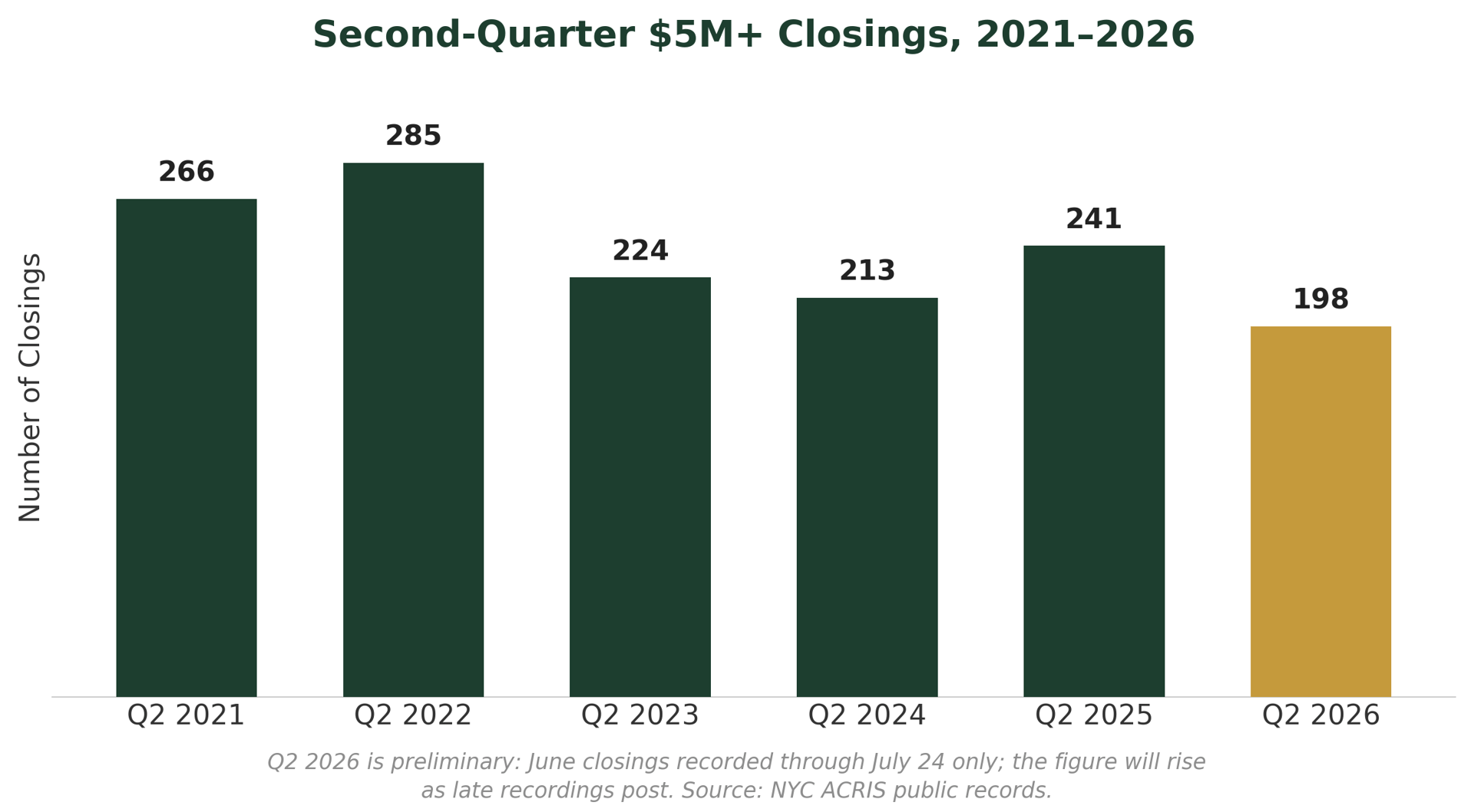
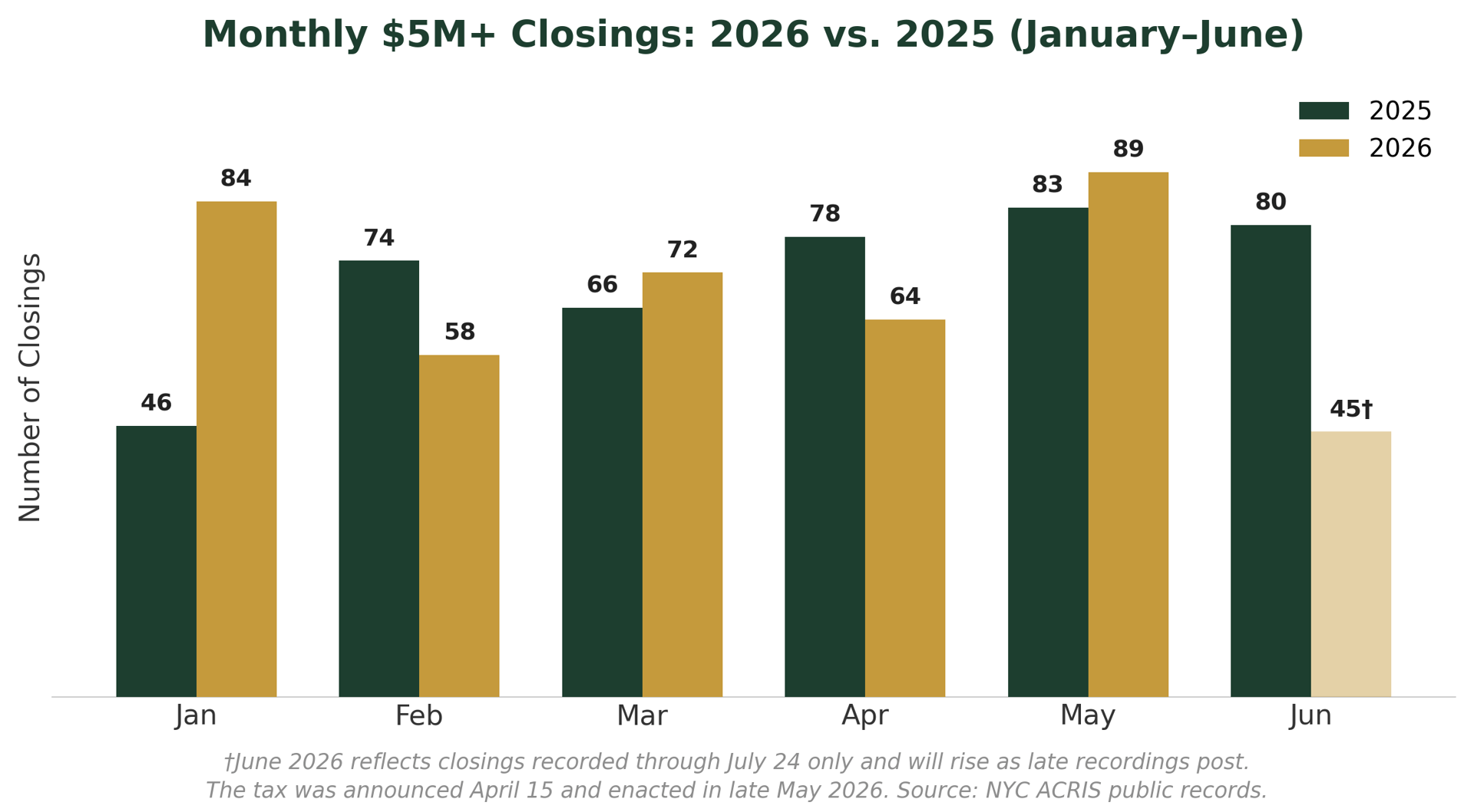
The honest read of Q2 requires the recording-lag caveat: deeds post to the public record weeks — sometimes 60–90 days — after closing, so June 2026 is still filling in, while every earlier quarter shown is complete. On the cleaner April–May comparison, 2026 recorded 153 closings against 161 in the same months of 2025 — a modest 5.0% softer, not the 18% the raw quarter suggests. The month-by-month picture makes the timing visible:
Month | 2025 | 2026 | YoY |
† June 2026 reflects recordings through July 24 only and is not yet comparable; with a recording lag that can run 60–90 days, a meaningful share of June closings has not yet posted.
The one month that clearly softened was April — the month the tax was announced (64 closings vs. 78 a year earlier, -17.9%). May — the month it was enacted — came in above last year (89 vs. 83, +7.2%). We would resist reading a single month as proof of anything; what the pattern does not show is a stampede to close ahead of the July 1 effective date.
The non-resident share: first wobble after a two-year climb
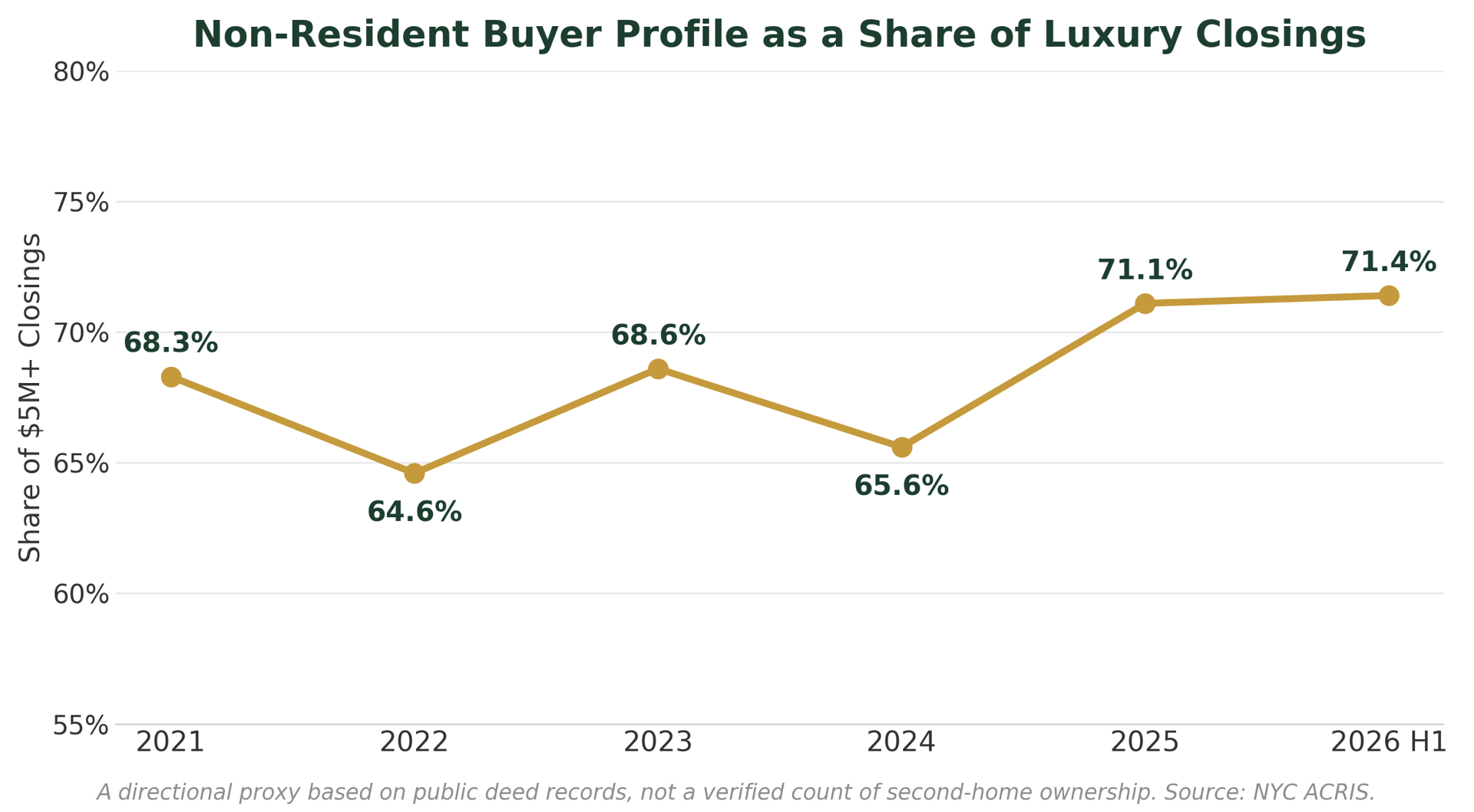
The series this report exists to track — the share of luxury closings fitting a non-resident buyer profile — printed 71.4% for the first half of 2026. That is off the early-2026 peak we reported in the first installment (roughly 74% for January through late April) and 1.7 points below the first half of 2025, driven by a Q2 reading of 69.2% after Q1's 73.4%. Context matters: 69.2% is still the second-highest second quarter in our six-year dataset, and the full-year 2025 figure (71.1%) remains the high-water mark. Whether Q2's dip is the first behavioral response to the tax or ordinary quarter-to-quarter noise is exactly what the next two installments will establish.
Metric | Q2 2025 | Q2 2026* | YoY | H1 2025 | H1 2026* | YoY |
* Preliminary: June 2026 closings are recorded only through July 24, 2026; Q2 and H1 2026 figures will revise upward as late recordings post. The 2025 comparatives are fully recorded, so the 2026 year-over-year comparisons carry a modest downward bias.
A structural tell: trusts keep rising
One quieter shift continues beneath the headline share: trust buyers accounted for 17.5% of H1 2026 closings — roughly level with 2025 (16.0%) but well above the ~10–11% that prevailed in 2021–2023. Estate- and privacy-driven structuring was growing before the tax existed; a surcharge keyed to how a property is used gives high-end buyers another reason to formalize ownership structures, and it is a line we will keep watching.
A Note on International Buyers
The finding that most surprises people remains intact — and this quarter sharpened it. In the public conversation, “pied-à-terre” is often shorthand for foreign ownership. Yet in the entire second quarter of 2026, not a single recorded $5 million-plus Manhattan deed listed a non-U.S. country in the buyer's address of record; across the first half, the figure was 0.7%. As we noted in the first installment, this dramatically understates true international ownership — overseas buyers overwhelmingly purchase through U.S.-registered entities that list a domestic address on the deed. It is why our broader non-resident proxy, not the country field, is the better catch-net, and why single-field headlines about foreign buyers rarely tell the whole story.
If You Received a Letter: What Owners Should Know
The Department of Finance began mailing notices on July 23 to owners of roughly 13,000 properties that may be covered, and published a supplemental market value roll on July 24. If a letter arrives, note the deadline: applications were originally due in late August, but on August 1 the city extended the deadline to September 18, 2026 for everyone who received a "You may be subject to…" notice — pairing the extension with expanded outreach through co-op and condo boards, property managers, senior centers and elected officials' offices. "Anyone who received a letter and believes they may qualify for an exemption should take advantage of this additional time," DOF Commissioner Richard Lee said.
The surcharge does not apply if the property is the primary residence of the owner, a tenant or subtenant, an immediate family member, individuals collectively holding a majority interest in the owning entity, or the sole beneficiary of a trust — DOF's exemption eligibility tool walks through the questions and lists the documents to have ready, and the surcharge page (nyc.gov/npsurcharge) hosts the applications, detailed guidance, and the secure upload portal; 311 operators have also been trained on the program. For properties that do owe it, the rates are:
Property Type | DOF Market Value | Surcharge Rate |
Rates for property tax years 2026–27 and 2027–28, applied to the property's Department of Finance market value — not its sale price. Condo/co-op rates are higher because DOF values those properties well below market. Source: NYC Department of Finance.
Where the letters are landing
The city's published roll gives the first complete picture of the potential tax base across all five boroughs:
Borough | 1-3 Family Homes | Condos & Co-Ops | Total Properties | DOF Market Value |
Unique properties by borough and class on the DOF supplemental market-value roll, published July 24, 2026. The roll casts a wide net: co-op buildings are listed whole, and many listed properties will qualify for primary-residence exemptions. Source: NYC Department of Finance.

Photo by Rihards Gederts | Howard Hanna NYC
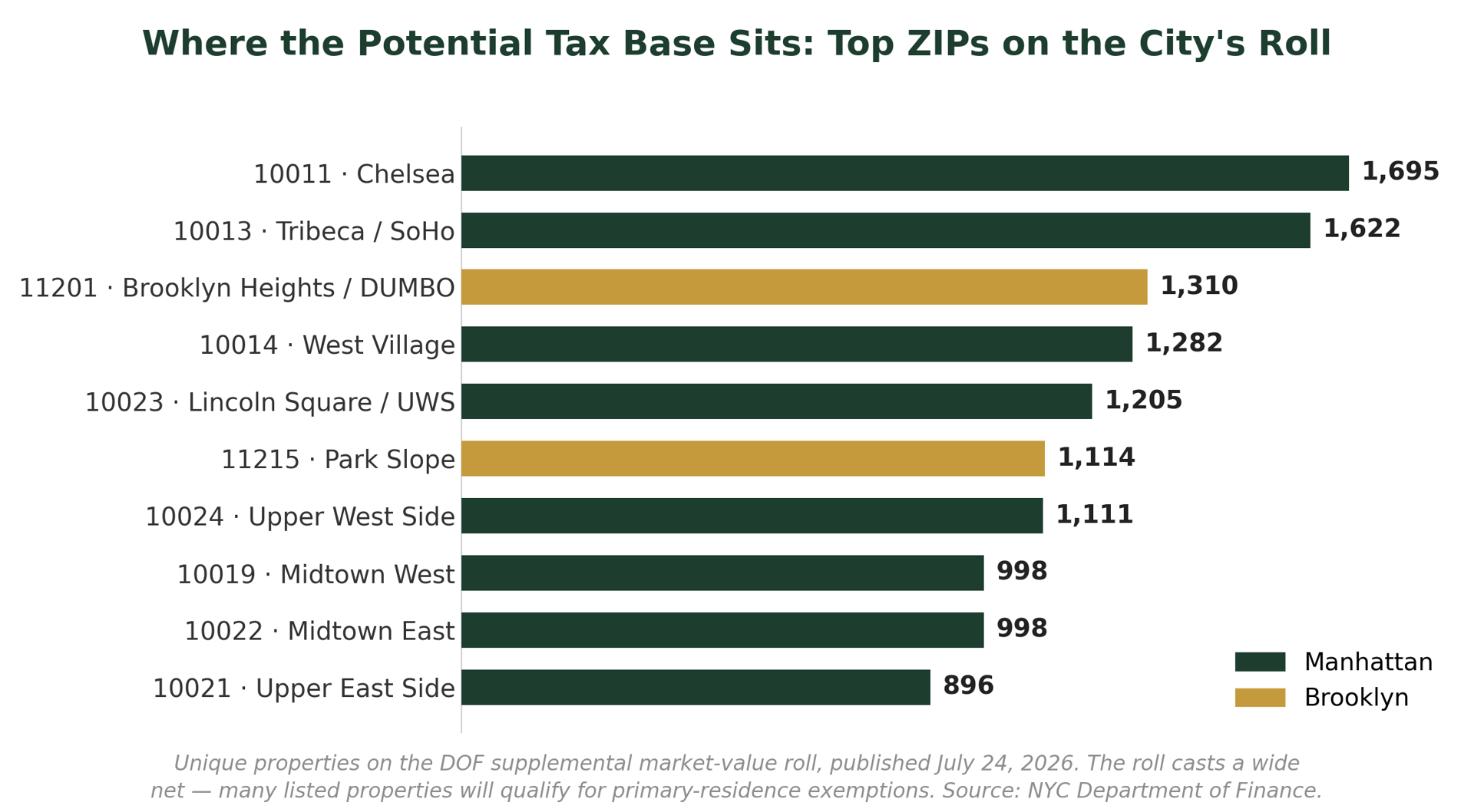
Two things stand out. First, the condo/co-op weight is what separates the boroughs — Manhattan's 15,118 listed units dwarf everyone else's. Second, and less expected: Brooklyn nearly matches Manhattan in $5M+ one- to three-family homes on the roll, 3,310 townhouses and brownstones against Manhattan's 3,356. The brownstone belt is squarely inside this tax's scope. The roll also shows where the potential tax base sits within the boroughs — and it is more concentrated, and less Park-Avenue-centric, than the stereotype.
The single largest ZIP codes on the roll are downtown-west Manhattan — Chelsea (10011), Tribeca/SoHo (10013) and the West Village (10014) — with the Upper West Side close behind; the top five ZIPs alone hold roughly 37% of Manhattan's listed properties. By dollar value, the Upper East Side's 10021 leads the city at $11.8 billion across fewer properties. And notably, two Brooklyn ZIPs crack the citywide top six: Brooklyn Heights/DUMBO (11201) ranks third overall and Park Slope (11215) sixth — a preview of why this series is expanding.
What this means for sellers — and buyers
If you own a covered property and are weighing your options, the rules reward genuine occupancy: a home that is the primary residence of a bona fide tenant is generally exempt, so owners not using their apartments may find that a real, market-rate lease changes the calculus of holding — though the final rules disqualify leases entered “primarily for the purpose of avoiding” the surcharge, so structure matters and advice should come from your attorney or tax professional. Our advisors can tell you what your property would command as a rental, and what selling into today's top-heavy market looks like.
If you are a buyer, the second half of 2026 may be the most interesting window this market has offered in years: some noticed owners will choose to sell rather than pay or lease, appeal outcomes land through the fall, and a surcharge measured in whole percentage points of value gives a well-advised buyer a concrete number to negotiate with. If the non-resident share of purchases keeps easing, motivated-seller dynamics would build through Q3 and Q4 — exactly the window our next installment covers. Talk to a Howard Hanna NYC advisor about positioning for it.
Putting the Numbers in Context
The data still does not argue for or against the tax; it measures the base the tax will operate on. (“The second home tax is a win for New York,” The New York Times editorial board wrote in July — the politics, we leave to others.) With collection now live, the revenue question — the city's ~$500 million projection against the Comptroller's $340–380 million estimate — turns on behavior: how many of the roughly 13,000 noticed owners qualify for exemptions, appeal, restructure, lease, sell, or simply pay. Q2 was the last quarter in which none of those incentives were in force at closing. It showed a market slightly softer in count, stronger in price, with the non-resident share easing off its peak but holding near the top of its six-year range — a high baseline, measured at the last possible moment it could be called untreated.
What we'll track next: the third quarter is the first fully inside the tax era. Contracts signed after enactment will close through Q3 and Q4, and the extended September 18 exemption deadline and the first appeal wave land in the same window. If the tax changes behavior, the first places it should show are the non-resident share, the trust and entity mix, and the pace of $5M–$8M closings — and we will report all three in the Q3 installment. Beginning with that installment, we will also extend the series to Brooklyn, where preliminary data shows the non-resident share climbing toward Manhattan levels.
Frequently Asked Questions
What is the NYC pied-à-terre tax?
An annual surcharge on certain New York City residential properties that are not used as the owner’s primary residence. It was enacted in late May 2026 as part of New York State’s FY2026–27 budget, took effect for the fiscal year beginning July 1, 2026, and is currently scheduled to expire June 30, 2031 unless renewed. It is charged annually, in addition to existing property taxes, based on the property’s Department of Finance market value and the rate for its bracket.
Who could be affected?
High-value NYC second homes. For property tax years 2026–27 and 2027–28 the surcharge may apply to one- to three-family homes with a DOF market value above $5 million and condominium or co-operative units with a DOF market value of $1 million or more. Because the city values condos and co-ops well below their sale prices, that $1 million threshold generally corresponds to a sale price of roughly $5 million or more. Primary residences are exempt.
I received a letter — do I definitely owe the surcharge?
No. The city is deliberately casting a wide net: the roll of roughly 26,000 properties “includes, but is not limited to” those that may be subject, and letters go to owners the city believes may qualify. If the property is a primary residence — yours, a family member’s, or a bona fide tenant’s — it is generally exempt once you document it — and after the August 1 extension, you now have until September 18, 2026 to apply. Run the eligibility tool, respond on time, and don’t panic.
Has the city started enforcing it?
Yes. DOF mailed the first notification letters on July 23, 2026 to owners of roughly 13,000 potentially covered properties and launched a dedicated surcharge page with an eligibility tool and secure document portal. Exemption applications were originally due in late August; on August 1, 2026 the city extended the deadline to September 18, 2026 for all noticed owners. Determinations can be appealed within 30 days through the Office of Administrative Tax Appeals, which added staff for the program.
If the property is someone’s primary residence, is it still taxed?
No. A property is generally exempt if it is the primary residence of the owner, a tenant or subtenant, an immediate family member, individuals collectively holding a majority interest in the owning LLC, corporation or partnership, or the sole beneficiary of a trust — with documentation (most recently filed tax return, or supporting IDs) submitted through DOF’s portal. Under the final rules, leases entered “primarily for the purpose of avoiding” the surcharge do not qualify, and claims are subject to audit.
How is the surcharge calculated?
As an annual percentage of the property’s DOF market value — not its sale price and not the assessed value on a tax bill — at the rate for its bracket (see the table above: 0.8–1.3% for one- to three-family homes, 4.0–6.5% for condos and co-ops during the initial phase). Owners should confirm their DOF market value and consult a tax professional.
Is Manhattan’s luxury market slowing because of the tax?
Not in the data available so far — see the analysis above. The tax took effect July 1, 2026, and closings lag signed contracts by 60–90 days, so a market response would first appear in late-2026 data, which we will track in the Q3 installment.
What should I do if I think my property is affected?
Watch for the DOF letter, note the deadline (extended to September 18, 2026), run the exemption eligibility tool, gather the documents it lists, and submit through nyc.gov/npsurcharge — or call 311. Consult a qualified attorney or tax professional about your specific circumstances. This FAQ is general information, not tax, legal, or financial advice.
References & Websites to Visit
For property owners:
• NYC DOF — Non-primary residence surcharge (guidance, applications, portal): https://www.nyc.gov/site/finance/property/non-primary-residence-surcharge.page
• DOF Exemption eligibility tool: https://www.nyc.gov/site/finance/property/property-surcharge-eligiblity-tool.page
• NYC 311 — operators trained on the surcharge and appeals process: portal.311.nyc.gov or call 311
Official announcements & analysis:
• Office of the Mayor — “Mayor Mamdani Notifies Property Owners of New Pied-à-Terre Tax” (July 23, 2026): https://www.nyc.gov/mayors-office/news/2026/07/mayor-mamdani-notifies-property-owners-of-new-pied-a-terre-tax
• Office of the Mayor — “Mayor Mamdani and Commissioner Lee Extend Deadline for Pied-à-Terre Tax Exemption Application” (August 1, 2026): https://www.nyc.gov/mayors-office/news/2026/08/mayor-mamdani-and-commissioner-lee-extend-deadline-for-pied-a-te
• Office of the NYC Comptroller — revenue analysis: comptroller.nyc.gov
The data & this series:
• NYC Open Data — ACRIS property records: data.cityofnewyork.us
• Part 1 of this series: https://howardhannanyc.com/blog/manhattan-pied-a-terre-tax-5m-sales
Sources
• Transaction data — NYC Department of Finance, ACRIS (Real Property Master, Legals, Parties), via NYC Open Data. Figures reflect Howard Hanna NYC’s own analysis of Manhattan residential deeds of $5 million or more recorded January 2021 – July 2026 (pulled July 24, 2026).
• Supplemental market-value roll and borough/ZIP tabulations — NYC Department of Finance, published July 24, 2026.
• “Mayor Mamdani Notifies Property Owners of New Pied-à-Terre Tax” (July 23) and “…Extend Deadline for Pied-à-Terre Tax Exemption Application” (August 1) — Office of the Mayor of New York City.
• Non-primary residence surcharge rates, exemptions and deadlines — NYC Department of Finance (nyc.gov/npsurcharge).
• Revenue projections — Offices of the Governor and Mayor (≈$500M/yr); NYC Comptroller, “The Pied-à-Terre Tax and Its Potential Revenues” ($340–380M, April 2026).
• Final rule amendments (July 21, 2026) — NYC Department of Finance; reporting by The Real Deal and https://therealdeal.com/new-york/2026/08/10/court-order-temporarily-halts-nycs-pied-a-terre-tax-rollout/
Important disclaimer: This article is provided for general informational and educational purposes only. It does not constitute, and should not be relied upon as, tax advice, legal advice, investment advice, financial advice, or accounting advice of any kind, nor is it a recommendation to buy, sell, or hold any property or security. Howard Hanna NYC is a licensed real estate brokerage and is not a law firm, accounting firm, tax advisor, or registered investment adviser. The surcharge described here remains subject to Department of Finance implementing rules and guidance that may affect how it applies. Consult a qualified attorney, tax professional, or financial advisor regarding your specific circumstances.
About the data: Figures are derived from public property records and reflect a methodological proxy for non-resident ownership based on signals such as ownership structure and the buyer’s address of record. The proxy is not a verified determination of any property’s use or any owner’s residency, and classifications for individual transactions may be inaccurate. Co-op transfers are underrepresented in the public record and may not be fully captured. Recent periods are understated by a 60–90 day recording lag and will revise upward.
If you would like to chat about the most recent market activity,
feel free to contact us at [email protected] or connect with one of our Advisors.
Howard Hanna NYC brings the nation’s largest independent and family-owned brokerage to New York City, uniting the strength of a national network with the insight and sophistication of a local firm. Formed through joining forces with Elegran Real Estate, Howard Hanna NYC delivers a seamless, full-service experience backed by more than 15,000 agents across 500 offices in 14 states. The firm’s forward-thinking, agent-first culture continues to shape the future of real estate across Manhattan and the Tri-State area.Learn more at www.howardhannanyc.com.