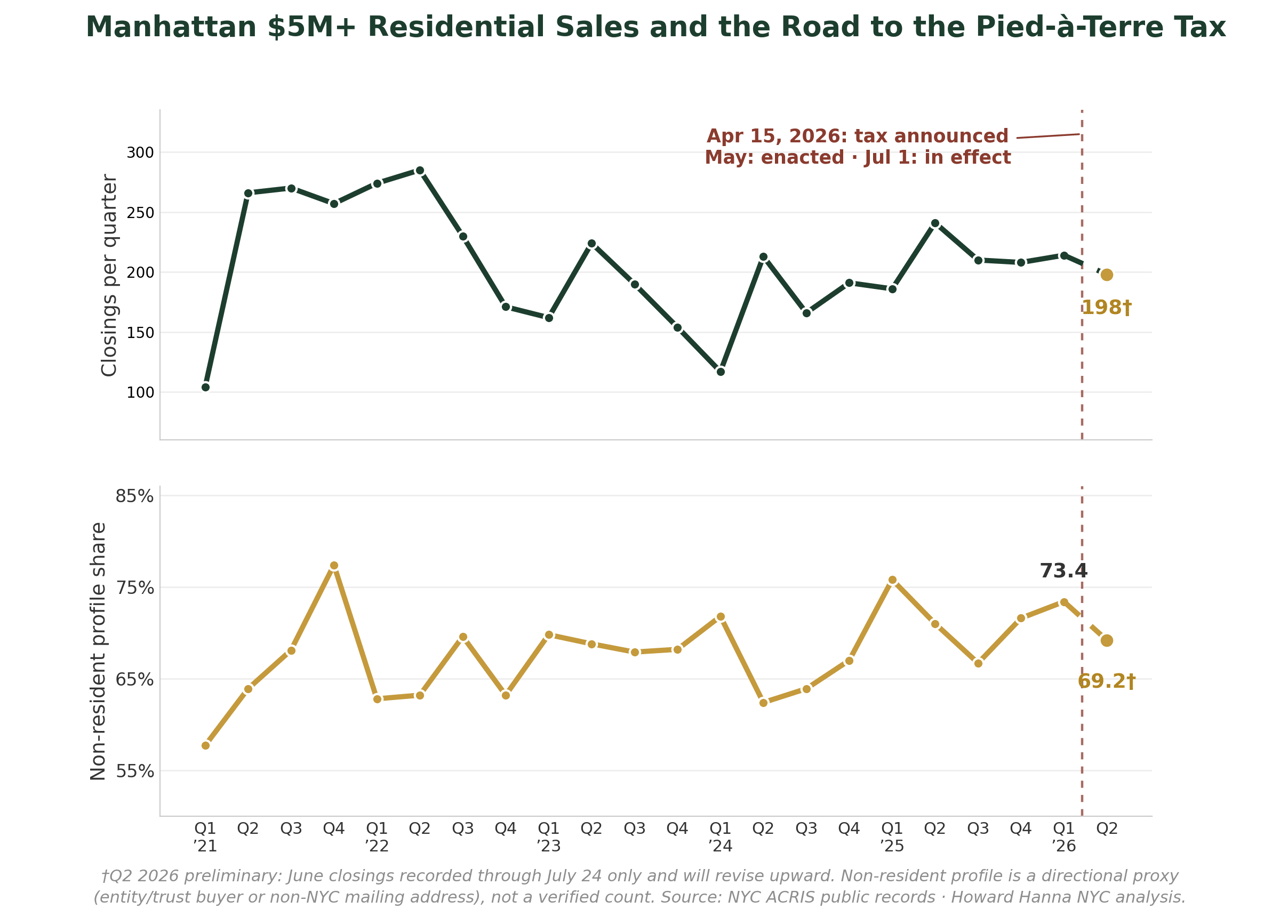
In April 2026, New York State and City leaders enacted a new annual tax on city residential properties valued at $5 million and above whose owners maintain a primary residence elsewhere — commonly called a "pied-à-terre tax," and in much of the press a "billionaire tax." The proposal revived a familiar question: who owns the city's most expensive homes, and what a tax like this means for the luxury market?
It is a question that has been debated far more than it has been measured. "Pied-à-terre" — a second home, a part-time residence — describes how a property is used, not a category recorded in any deed or tracked by any commercial real estate platform. So at Howard Hanna NYC, we looked at the public record directly.
Key takeaway: Howard Hanna NYC analyzed more than 4,000 Manhattan residential deeds of $5 million or more recorded between 2021 and 2026. The share of these luxury sales fitting a non-resident buyer profile rose from about 68% to about 74% over the period, even as overall luxury sales held steady. The figures are a directional proxy drawn from public ACRIS records, not a verified count.

Photo by Rihards Gederts | Howard Hanna NYC
Our Approach
Drawing on New York City's public property records, we examined more than 4,000 residential sales of $5 million or more in Manhattan recorded between January 2021 and May 2026.
Because no record explicitly labels a property as a pied-à-terre, we developed a proxy to approximate non-resident ownership, built on signals available in the public deed record. Applied consistently across the full five-year period, it lets us track how the non-resident share of the luxury market has shifted over time.
We want to be clear about what this is and is not: it is a directional proxy, not a verified count of pied-à-terres. A property's ownership structure and the address on a deed are useful indicators, but they are not the same as a confirmed residency status — a point the City Comptroller's own review of the proposal also emphasized. We therefore read these figures as a directional measure of a trend, not a precise tally.
What the Data Shows
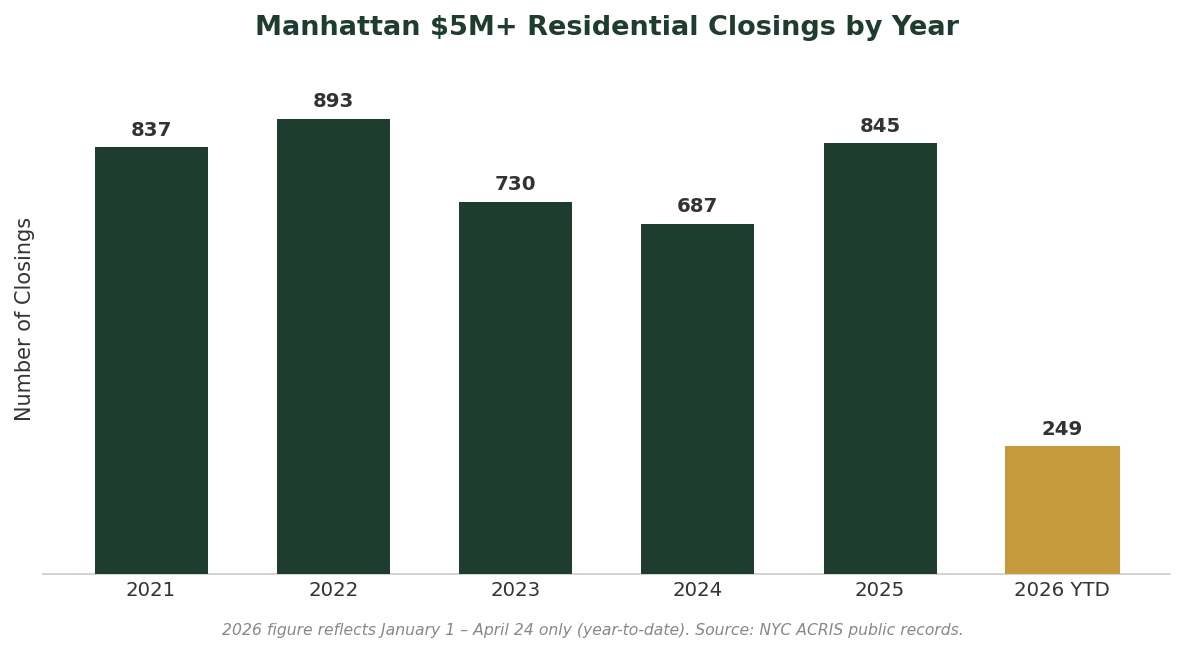
First, the luxury market has remained active. After softer years in 2023 and 2024, high-end closings recovered in 2025, and 2026 is pacing in line with that recovery. Through the first months of 2026, both dollar volume and median price are up modestly year-over-year against the same period in 2025 — the median sale price crossed $8 million for the first time in our five-year dataset.
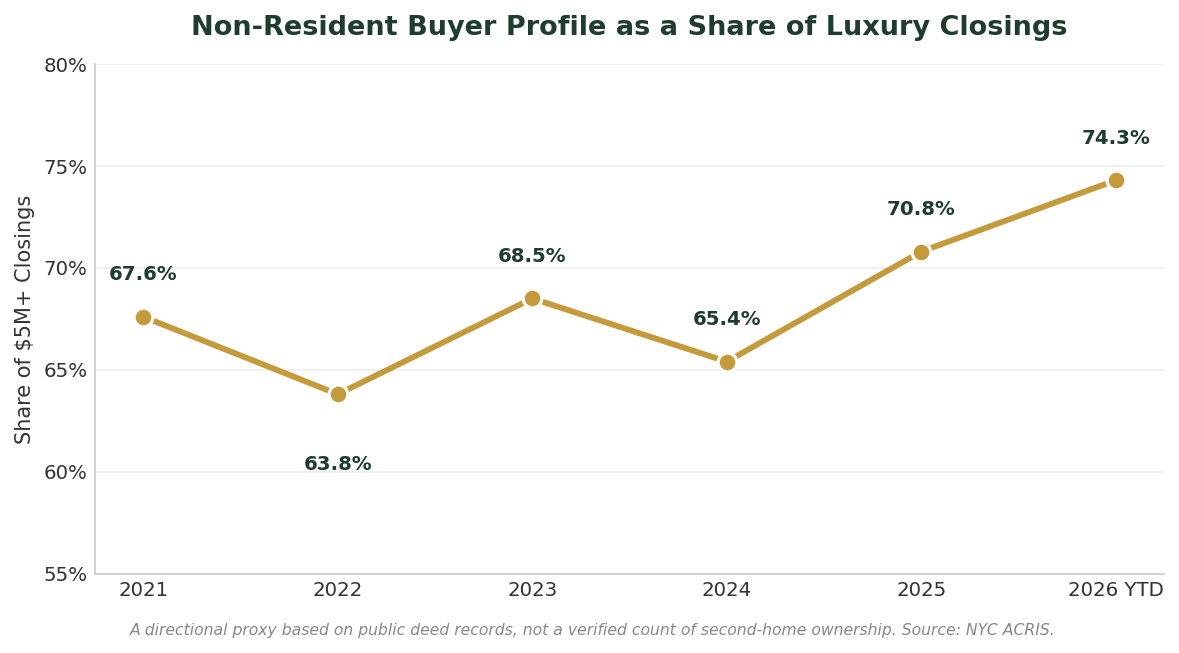
Second, and more striking: the share of these luxury closings fitting a non-resident profile has risen over the period — from roughly 68% in 2021 to about 74% in early 2026 — though not in a straight line, dipping in 2022 and 2024 before reaching its high point. In broad terms, the non-resident segment makes up a larger share of high-end purchases today than it did five years ago.
A Note on International Buyers
One finding cuts against a common assumption. In the public conversation, "pied-à-terre" is often shorthand for foreign ownership. Yet only about 1% of the sales we examined showed a non-U.S. country in the buyer's address of record. That figure dramatically understates true international ownership — not because overseas buyers are absent, but because many purchase through U.S.-registered entities that list a domestic address on the deed. It is a useful reminder that the headline numbers in any single data field rarely tell the whole story.
Putting the Numbers in Context
The data does not argue for or against the tax. What it does is add measurement to the debate. Revenue projections have ranged widely — the city projects roughly $500 million a year, while the City Comptroller's office estimated that, after accounting for rental exemptions and likely changes in owner behavior, collections could fall to between $340 million and $380 million. Such projections depend heavily on how the non-resident ownership base behaves over time. Our analysis speaks to one piece of that picture: the flow of new purchases fitting a non-resident profile has been a growing share of high-end activity, even as the absolute number of luxury transactions has moved within a relatively narrow band.
Whether the tax will change these patterns is too early to say. It was enacted in May 2026 and takes effect July 1, 2026; any market response would appear in transactions that close later in 2026 and beyond — which is exactly why we intend to keep tracking it.
What We'll Track Next : This is the first installment in what we intend as a quarterly series. We invite you to follow along.
Frequently Asked Questions
- What is the NYC pied-à-terre tax? The NYC pied-à-terre tax is a newly enacted annual surcharge on certain New York City residential properties that are not used as the owner's primary residence. It was enacted in late May 2026 as part of New York State's FY2026–27 budget, takes effect for the fiscal year beginning July 1, 2026, and is currently scheduled to expire June 30, 2031 unless renewed. It is charged annually, in addition to existing property taxes, and is based on the property's city-assigned (Department of Finance) market value and the applicable rate. The NYC Department of Finance is responsible for identifying covered properties and notifying owners; affected owners are expected to be notified by August 30, 2026, and will have an opportunity to contest the determination.
- Who could be affected by the pied-à-terre tax? The tax applies to high-value New York City second homes — residential property that is not the owner's primary residence. The value thresholds differ by property type: for one- to three-family homes, a Department of Finance (DOF) market value of $5 million or more; for condominiums and cooperatives, a DOF market value of $1 million or more during the initial phase (2026–2028). Because the city values condos and co-ops well below their sale prices, that $1 million condo/co-op threshold generally corresponds to a sale price of roughly $5 million or more. Primary residences are exempt. Ownership structures, occupancy arrangements, and forthcoming Department of Finance guidance may affect how the rules apply in specific cases.
- If the property is someone's primary residence, is it still taxed? No. The surcharge applies only to non-primary residences. A property is generally exempt if it is used as a primary residence by the owner, by an immediate family member (spouse, child, sibling, parent, grandparent, or grandchild), or by a qualifying tenant under a bona fide, arm's-length lease of at least one year. Owners may be required to certify primary-residence status and provide supporting documentation, which the Department of Finance is authorized to audit for up to six years.
- How is the surcharge calculated? The surcharge is an annual percentage of the property's DOF market value — not its sale price and not the regular assessed value on a tax bill — at the rate for its value bracket. During the initial phase, condos and co-ops are taxed at higher rates than one- to three-family homes to offset their lower city valuations. Because the exact figure depends on a property's DOF market value and on final Department of Finance rules, owners should confirm their current market value through the NYC Department of Finance property search and consult a tax professional about their specific situation.
- How much revenue would the pied-à-terre tax raise? New York City projects roughly $500 million a year. The NYC Comptroller's office estimated that, after accounting for rental exemptions and changes in owner behavior, actual collections could fall to between $340 million and $380 million.
- Is Manhattan's luxury market slowing because of the tax? Not in the data available so far. Howard Hanna NYC's analysis of public deed records shows $5 million-plus Manhattan closings recovered in 2025, and 2026 has been pacing similarly, with the median sale price crossing $8 million. Because the tax takes effect July 1, 2026, and closings lag signed contracts by 60–90 days, any market response would first appear in later-2026 data, which we will continue to track.
- How many Manhattan luxury buyers are non-residents? Using a directional proxy based on public deed records, the non-resident share of $5 million-plus Manhattan closings rose from about 68% in 2021 to about 74% in early 2026. This is an approximation based on ownership structure and the buyer's address of record, not a verified residency determination.
- What should I do if I think my property is affected? Confirm your current DOF market value through the NYC Department of Finance, watch for the Department's notice (expected by August 30, 2026), and review your situation with a qualified tax attorney or advisor — particularly if you own through an LLC or trust, or intend to claim an exemption based on family use or a lease. Note: This FAQ is general information, not tax, legal, or financial advice. The tax remains subject to Department of Finance implementing rules and guidance that may affect how it applies. Consult a qualified attorney or tax professional about your specific circumstances.
Sources
- Transaction data — New York City Department of Finance, ACRIS, via NYC Open Data. Figures reflect Howard Hanna NYC's own analysis of Manhattan residential deeds of $5 million or more recorded January 2021–May 2026. data.cityofnewyork.us
- Tax proposal and $500M projection — Office of Governor Kathy Hochul, press release, April 15, 2026.
- Tax scope and primary-residence exclusion — Office of the Mayor of New York City, press release, April 15, 2026.
- Revenue revision ($340–380M) — Office of the New York City Comptroller, "The Pied-à-Terre Tax and Its Potential Revenues," April 2026. comptroller.nyc.gov
Important disclaimer: This article is provided for general informational and educational purposes only. It does not constitute, and should not be relied upon as, tax advice, legal advice, investment advice, financial advice, or accounting advice of any kind, nor is it a recommendation to buy, sell, or hold any property or security. Howard Hanna NYC is a licensed real estate brokerage and is not a law firm, accounting firm, tax advisor, or registered investment adviser. The pied-à-terre tax described here had not been enacted as of the date of writing and remained subject to legislative approval; its scope, rates, exemptions, and effective date may change. Any decision regarding real estate, taxes, or investments should be made only after consulting a qualified attorney, tax professional, or financial advisor regarding your specific circumstances.
About the data: Figures are derived from public property records and reflect a methodological proxy for non-resident ownership based on signals such as ownership structure and the buyer's address of record. The proxy is not a verified determination of any property's use or any owner's residency, and classifications for individual transactions may be inaccurate. Co-op transfers are underrepresented in the public record and may not be fully captured.
If you would like to chat about the most recent market activity,
feel free to contact us at [email protected] or
connect with one of our Advisors.
Howard Hanna NYC brings the nation’s largest independent and family-owned brokerage to New York City, uniting the strength of a national network with the insight and sophistication of a local firm. Formed through joining forces with Elegran Real Estate, Howard Hanna NYC delivers a seamless, full-service experience backed by more than 15,000 agents across 500 offices in 14 states. The firm’s forward-thinking, agent-first culture continues to shape the future of real estate across Manhattan and the Tri-State area.Learn more at www.howardhannanyc.com.